Medicare can feel complicated at first.
You hear about Part A, Part B, Part C, Part D, Medicare Advantage, Medicare Supplements, deductibles, enrollment periods, and penalties—sometimes all in the same conversation.
But once you understand the basics, Medicare becomes much easier to navigate.
At Senior Savings Network, we help people understand how Medicare works, what it costs, when to enroll, and what additional coverage options are available.
This page will walk you through the Medicare basics for 2026.
GET MEDICARE HELP
Medicare is the federal health insurance program primarily for people age 65 and older.
Certain people under 65 may also qualify because of a disability or specific medical conditions.
Medicare is divided into different parts:
Medicare Part A — Hospital Insurance
Medicare Part B — Medical Insurance
Medicare Part C — Medicare Advantage
Medicare Part D — Prescription Drug Coverage
The first thing to understand is that these parts don't all work the same way.
Medicare Part A primarily helps pay for inpatient care.
It can help cover:
Most people don't pay a monthly premium for Part A because they or their spouse paid Medicare taxes long enough while working.
But premium-free doesn't mean cost-free.
Part A has deductibles and coinsurance when you use certain healthcare services.
Part A Monthly Premium
Most people pay:
$0 per month
If you don't have enough work history to qualify for premium-free Part A, you may be able to purchase it.
In 2026, the monthly Part A premium is:
The Part A inpatient hospital deductible is:
$1,736
Here's something important:
The Part A deductible is not necessarily a once-per-year deductible.
It applies to each benefit period.
A benefit period begins when you're admitted as an inpatient to a hospital or skilled nursing facility and generally ends after you've been out of inpatient hospital or skilled nursing facility care for 60 consecutive days.
That means it's possible to have more than one Part A deductible in the same calendar year.
During a Medicare Part A benefit period:
Days 1–60
After paying the $1,736 Part A deductible, you pay:
$0 per day
Days 61–90
You pay:
$434 per day
Days 91–150
You pay:
$868 per day while using your lifetime reserve days.
Medicare gives you a total of 60 lifetime reserve days.
After Day 150
Once your lifetime reserve days are exhausted, you generally pay all costs for additional inpatient hospital days in that benefit period.
Medicare Part A can also help cover skilled nursing facility care when Medicare's coverage requirements are met.
For a covered skilled nursing facility stay in 2026:
Days 1–20
You pay:
$0 per day
Days 21–100
You pay:
$217 per day
After Day 100
You generally pay:
All costs
Medicare Part B covers many of the healthcare services you receive outside of an inpatient hospital stay.
Part B can help cover:
Unlike Part A, almost everyone pays a monthly premium for Part B.
2026 Part B Premium
The standard Medicare Part B premium is:
$202.90 per month
Most Medicare beneficiaries pay this amount.
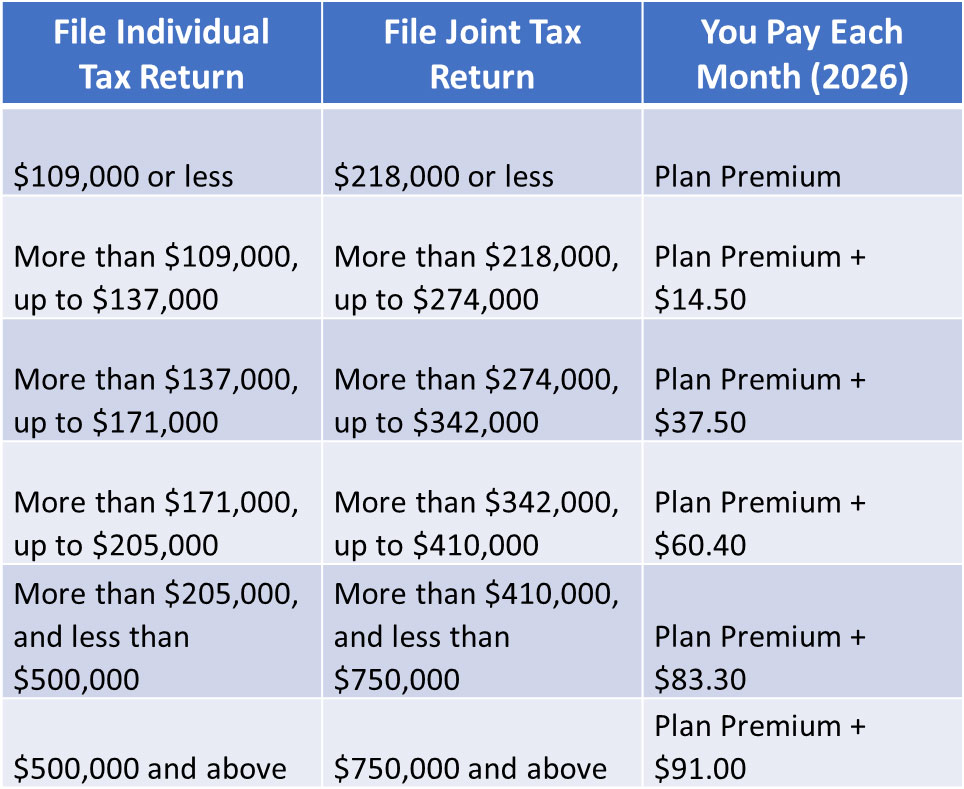
People with higher incomes may pay more because of the Income-Related Monthly Adjustment Amount, commonly called IRMAA.
For 2026, IRMAA begins when your 2024 modified adjusted gross income was above:
Depending on income, the total 2026 Part B monthly premium can be as high as $689.90.
The annual Medicare Part B deductible is:
$283
Unlike the Part A hospital deductible, this is an annual deductible.
Once you've met the Part B deductible, Original Medicare generally pays 80% of the Medicare-approved amount for covered Part B services, and you are responsible for the remaining 20%.
This is one of the most important Medicare costs to understand.
After your Part B deductible has been met, you typically pay:
20% of the Medicare-approved amount
for many Part B-covered services when your provider accepts Medicare assignment.
Medicare pays the other 80%.
And under Original Medicare alone:
There is no annual maximum on your Part A and Part B out-of-pocket expenses.
That's one of the main reasons people often consider additional coverage such as a Medicare Supplement plan to help with the deductibles and coinsurance left behind by Original Medicare.
LEARN ABOUT MEDICARE SUPPLEMENTS
Medicare Part C is better known as Medicare Advantage.
Medicare Advantage is another way to receive your Medicare Part A and Part B benefits.
Instead of receiving those benefits directly through Original Medicare, you enroll in a Medicare Advantage plan offered by a private insurance company approved by Medicare.
Many Medicare Advantage plans may also include:
The exact benefits depend on the plan.
There isn't one standard Medicare Advantage premium, deductible, or copayment.
Costs vary by plan.
Some Medicare Advantage plans may have a low additional monthly premium, while others charge a higher monthly premium.
However:
You must continue paying your Medicare Part B premium.
For most people, that's $202.90 per month in 2026.
Medicare Advantage plans may also charge:
Unlike Original Medicare by itself, Medicare Advantage plans have an annual maximum out-of-pocket limit for covered Part A and Part B services. The specific limit depends on the plan.
LEARN ABOUT MEDICARE ADVANTAGE
Medicare Part D helps pay for prescription medications.
Part D coverage is offered by private insurance companies approved by Medicare.
If you have Original Medicare, you can purchase a stand-alone Part D prescription drug plan.
Many Medicare Advantage plans include Part D coverage directly in the plan.
Part D premiums, copayments, coinsurance, drug formularies, and pharmacy networks vary by plan.
However, Medicare sets certain limits.
Maximum Part D Deductible for 2027
A Medicare Part D plan can charge a deductible of up to:
$700
Some plans have a lower deductible, and some may have no deductible at all.
2027 Prescription Drug Out-of-Pocket Limit
In 2027, your annual out-of-pocket costs for covered Part D prescription drugs are capped at:
$2,400
Once your qualifying out-of-pocket spending reaches $2,400, you pay $0 out of pocket for covered Part D drugs for the rest of that calendar year.
Once you have Medicare, one of your biggest decisions is how you want to receive your coverage.
There are generally two main paths.
You keep:
Medicare Part A + Medicare Part B
You may then add:
Medicare Supplement Insurance + Medicare Part D
A Medicare Supplement can help pay some of the deductibles and coinsurance left behind by Original Medicare.
You enroll in:
Medicare Part C
Your private Medicare Advantage plan provides your Part A and Part B benefits.
Most Medicare Advantage plans also include Part D prescription drug coverage.
These two approaches work very differently.
The right choice depends on your healthcare needs, doctors, prescriptions, budget, travel habits, and personal preferences.
COMPARE MY MEDICARE OPTIONS
Medicare enrollment timing matters.
Missing an enrollment period can potentially cause:
That's why understanding your enrollment timeline before you turn 65 is so important.
For most people becoming eligible for Medicare at age 65, your Initial Enrollment Period lasts seven months.
It includes:
3 months before the month you turn 65
The month you turn 65
3 months after the month you turn 65
For example:
If your birthday is in August, your Initial Enrollment Period generally runs from:
May 1 through November 30.
If you enroll in Part B before the month you turn 65, your coverage generally begins the first day of the month you turn 65.
If you enroll during your birthday month or one of the three following months, coverage generally begins the month after you enroll.
If your birthday is on the first day of the month, Medicare generally treats you as reaching age 65 during the previous month for purposes of when coverage begins.
Some people are automatically enrolled in Medicare Part A and Part B.
Others must actively sign up.
If you're already receiving certain Social Security or Railroad Retirement Board benefits before becoming eligible for Medicare, you may be enrolled automatically.
If you aren't receiving those benefits yet, you may need to enroll through Social Security.
Don't assume Medicare automatically starts just because you turn 65.
Check your enrollment status before your Medicare eligibility date.
You may not always need to enroll in Part B immediately if you have qualifying group health insurance through current employment—either your job or your spouse's job.
In that situation, you may qualify for a Special Enrollment Period.
For employer coverage based on current employment, the Part B Special Enrollment Period generally lasts while the qualifying coverage continues and for up to:
8 months after the employment or group health coverage ends, whichever happens first.
But be careful.
COBRA and retiree coverage aren't treated the same as active employer coverage for this Part B enrollment rule.
Having COBRA or retiree insurance does not necessarily protect you from a Part B late enrollment penalty.
Before delaying Medicare because you're working past 65, verify how your employer coverage coordinates with Medicare.
GET HELP WITH MY MEDICARE TIMELINE
If you miss your Initial Enrollment Period and don't qualify for a Special Enrollment Period, you may have to use Medicare's General Enrollment Period.
It runs:
January 1 through March 31 each year.
If you enroll during the General Enrollment Period, your coverage generally begins the first day of the month after you enroll.
Late enrollment penalties may apply.
There's another enrollment period you'll hear about every fall.
October 15 through December 7
This is Medicare's annual Open Enrollment Period for Medicare Advantage and Medicare prescription drug plans.
During this period, you can generally:
Changes generally take effect January 1.
This is not the same as your Initial Enrollment Period.
October 15–December 7 is primarily a time for people who already have Medicare to review and change their health or prescription drug coverage for the following year.
If you're already enrolled in Medicare Advantage, there's another enrollment opportunity from:
January 1 through March 31
During the Medicare Advantage Open Enrollment Period, you can generally make one change.
You can:
If you return to Original Medicare, you can also enroll in a stand-alone Part D drug plan.
This period does not allow someone with Original Medicare to enroll in Medicare Advantage.
One of the biggest Medicare mistakes is assuming you can simply enroll whenever you want.
In some situations, waiting can cost you money for years—or even for the rest of your life.
There are separate penalties for Part A, Part B, and Part D.
This penalty generally only matters if you have to pay a premium for Medicare Part A.
If you don't purchase Part A when you're first eligible and don't qualify for an exception, your monthly Part A premium may increase by:
10%
Unlike the Part B and Part D penalties, the Part A penalty isn't necessarily permanent.
You generally pay the higher premium for twice the number of years you delayed enrollment.
For example:
If you waited two years to enroll, you could pay the 10% higher premium for four years.
The Part B penalty can be much more significant.
If you don't enroll in Part B when you're first eligible and don't qualify for a Special Enrollment Period, your Part B premium can increase by:
10% for each full 12-month period you could have had Part B but didn't.
And in most cases:
You pay the penalty for as long as you have Medicare Part B.
For example, if you delayed Part B for two full years without qualifying for an exception, your penalty would generally be 20%.
Using the standard 2026 Part B premium:
$202.90 standard premium
+ 20% late enrollment penalty
Your 2026 monthly premium would be approximately:
$243.50 per month
That's why it's important to know whether your employer coverage actually allows you to delay Medicare before making that decision.
Part D has a different penalty.
You may owe a Part D late enrollment penalty if, after you're eligible for Medicare drug coverage, you go:
63 consecutive days or longer
without Medicare drug coverage or other creditable prescription drug coverage.
Creditable coverage generally means prescription drug coverage that's expected to pay, on average, at least as much as standard Medicare drug coverage.
The Part D penalty is generally calculated as:
1% × the national base beneficiary premium × the number of full uncovered months
For 2026, Medicare's national base beneficiary premium used to calculate the penalty is:
$38.99
The penalty is rounded to the nearest 10 cents and added to your Part D premium.
Because the national base beneficiary premium can change each year, the dollar amount of your penalty can also change.
In most cases, you continue paying the penalty for as long as you have Medicare drug coverage.
There isn't a separate late enrollment penalty specifically for Medicare Advantage, or Part C.
However, to join most Medicare Advantage plans, you must have both Medicare Part A and Part B.
And if your Medicare Advantage plan includes prescription drug coverage, the Part D late enrollment rules can still matter.
That's why your Part A, Part B, and prescription drug enrollment dates are important even if you ultimately want Medicare Advantage.
This is a common question.
You might think:
“I don't take any medications, so why would I need Part D?”
The issue is that Medicare's Part D late enrollment penalty isn't based on whether you currently need prescriptions.
It's based on whether you went without Part D or other creditable prescription drug coverage after becoming eligible.
That means someone who waits several years and later develops a need for expensive prescriptions could face both:
A lower-premium drug plan may sometimes make sense even if you currently take few or no medications.
Another important Medicare basic:
Original Medicare does not cover 100% of your healthcare expenses.
You can still have:
And Original Medicare does not have a yearly maximum on your Part A and Part B out-of-pocket costs.
That's why most people need to make additional coverage decisions when they become eligible for Medicare.
Once you have Medicare Part A and Part B, you'll typically need to decide how you want to handle the costs and services Original Medicare doesn't fully cover.
For many people, that means considering one of two approaches:
Original Medicare + Medicare Supplement + Part D
or
Medicare Advantage
Neither option is automatically right for everyone.
The goal is to understand how each works before you enroll.
A Medicare Supplement, also called Medigap, works alongside Original Medicare.
Original Medicare pays first.
Your Medicare Supplement can then help pay certain deductibles, copayments, and coinsurance left behind by Medicare, depending on which Supplement plan you choose.
Popular Medicare Supplement options include:
If you're approaching Medicare eligibility, start learning your options before your coverage needs to begin.
Understanding Medicare early gives you time to:
Your Medicare decisions can affect your healthcare and your budget for years to come.
You don't need to figure this out alone.
Senior Savings Network can help you understand:
We'll explain your options in plain language so you can make an informed decision.
Our help costs you nothing.
Call Senior Savings Network at 1-800-729-9590.
Or click below to request Medicare help.
GET FREE MEDICARE HELP